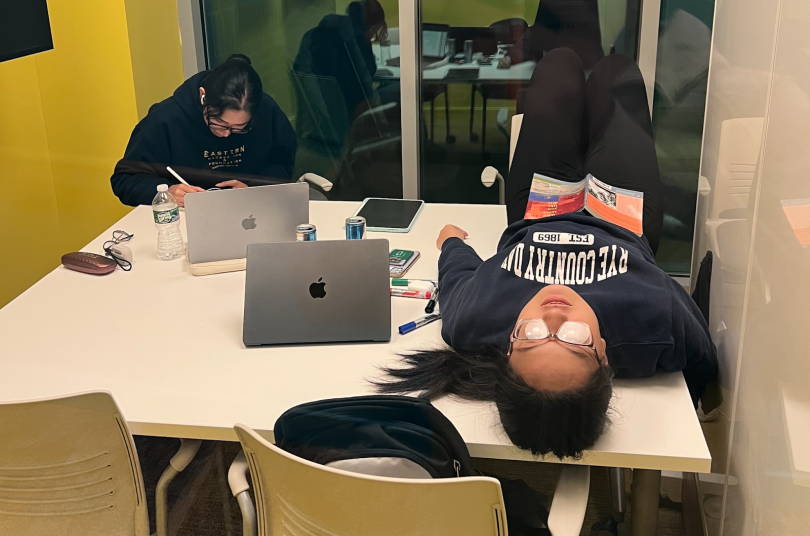
Hello, 你好! My name is Tao; I'm from New York City, and I'm a proud first-generation student. I'm currently interested in studying Math, Economics, and Philosophy. I love being immersed at campus–especially aesthetic Woccoms and soaking in the nature in the Upper Valley. Come one, come all: let me take you along!
At Dartmouth, we follow the quarter system, so each academic quarter is 10 weeks long. It's bittersweet—it's week 10 (and 11, for the students who have later exam dates)! To be frank, I came into Dartmouth thinking it was just like classes in high school, except the concept would get harder.
While this is true, it can be very easy to get distracted by the fact that most Dartmouth students take three courses per quarter. That is half of the courses I'd take in high school! But, at the same time, it is intentionally designed this way because no Dartmouth course is "easy." Currently, I'm taking CS1 Intro to Programming and Computation, Writing 5 Expository Writing, and Chinese 31 Advanced Modern Chinese. Writing 5 and CS1 are both designed for first-year students as introductory courses to computer science and first-year writing respectively. While they are called "introductory" courses, you learn so much in the 10 weeks that it's challenging! Chinese 31 isn't usually a first-year course, however, I was able to get permission to take the class with prior Chinese knowledge. For all three courses, generally speaking, there is a midterm exam/essay project every 3 weeks: totalling to about three major assignments per course per term.
Yes, Dartmouth is rigorous and challenging—but its emphasis on undergraduate teaching is noticeable. Compared to high school, most of my classes were lecture-based with a daily home outside of class. However, Dartmouth courses are designed to engage you! For example, my computer science class has weekly recitation where I get to try challenging problems with a small group of students and TA (teaching assistant) on the topic(s) we were learning about that week. In Writing 5, my professor brought apples to sample (we were talking about genetic diversity in produce that week). And in Chinese 31, I have drills every week that helps me sharpen my speaking skills! Classes are challenging, but that's what makes Dartmouth. Courses that prompt you to think critically.
If you are interested in pursuing medicine after graduating from high school, as I was, you'll be looking at how different universities design their "pre-health" experience. What does that experience look like at Dartmouth College?
Welcome back to Open Doors—your inside look at life in the Woods! This week, Isabelle Sullivan '26, an environmental studies and geography major, showed me around her room, where we discussed Dartmouth residence halls, classes, and campus life.
I've been blogging for almost two years now, and it's become one of my favorite extracurriculars on campus. Read on to hear why I've enjoyed it so much.
There was never a single "aha!" moment of clarity when I knew that Dartmouth was right for me, yet now, it is impossible for me to imagine having chosen anywhere else.