Hi everyone! My name's Daniel, and I'm a 25! I'm from Orange County, California and Seoul, South Korea. I'm hoping to major in Biomedical Engineering and Anthropology Modified with Global Health. If I'm not under my sheets watching a new Netflix series, you'll find me spending time at Still North Café or at the engineering building. I hope you learn something new about Dartmouth today!
Academic Program
Biomedical Engineering and Anthropology Modified with Global Health
The winter term, with daily temperatures reaching the negatives, I've been "actively" staying indoors to stay away from the cold! I've been ardently attending more office hours, meetings with organizations and advisors, and allocating more time for personal development. I've been contemplating, for all of fall term, what extracurricular activity I feel passionate about—what activity I'd want to dedicate significant amounts of time towards. My conclusion was science research!
I'm currently a research intern at Cramer laboratory at Geisel School of Medicine. My research investigates programmed cell death, or apoptosis, in "Aspergillus Fumigatus," a species of fungus. As some of you may know, immunocompromised individuals such as those who are undergoing chemotherapy or infected with diseases like AIDS or HIV are highly prone to fungal diseases—the immune system can no longer protect the skin from fungal penetration. When Aspergillus enters the tissues of your skin, it begins its work by causing significant cell death across your whole body. So, our lab's research probes methods of reversing and slowing down the process of apoptosis to assist those that are immunocompromised (especially cancer patients).
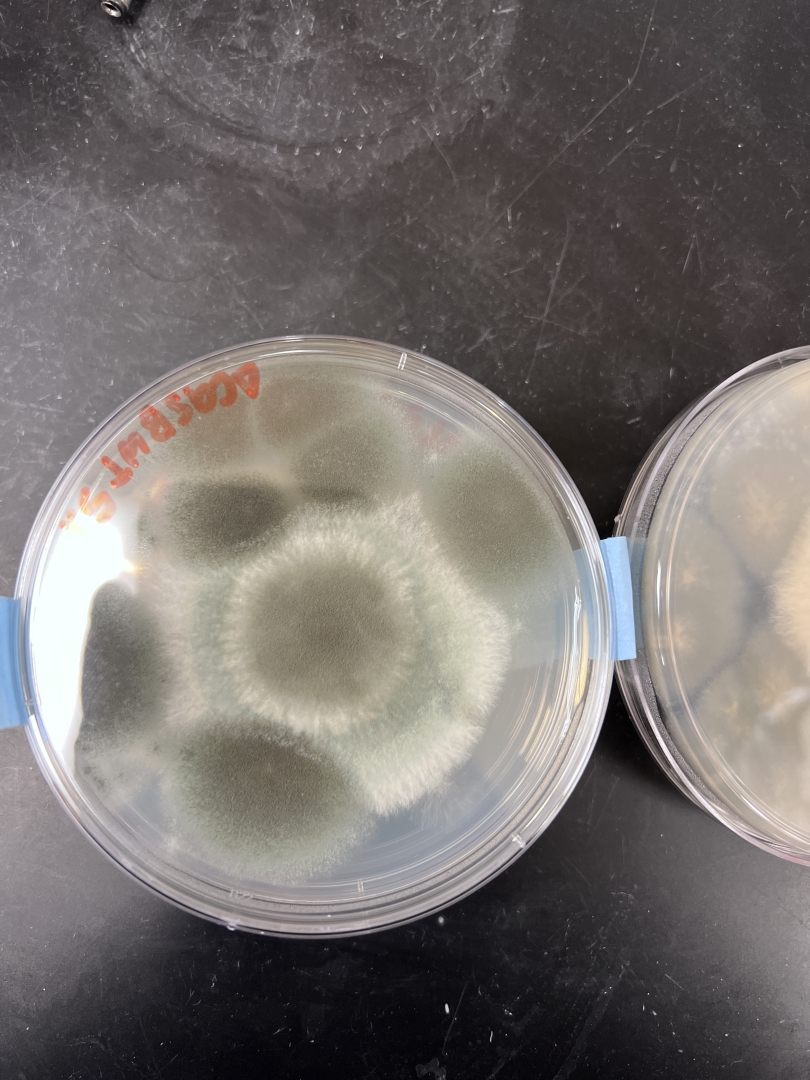
A contaminated petri with a combination of different fungal colonies!
What does my commitment look like?
Currently, I work 12-15 hours a week, spending my time at the lab for about 3 hours each day. What's great about being an undergraduate in a science lab is that you're able to formulate your own schedule according to your class schedule. I even have the weekends off! I was lucky enough to also become a paid intern, making money while doing something I love.
I began with basic laboratory skills like creating cultures, learning how to use pipettes and microscopes, and conducting PCR tests (yes, the same test we use for COVID-19). But, just after 3 weeks of working, I already began my own experiment, growing and analyzing my own set of fungal species. It has truly been a wonderful experience so far.
If you're interested in a specific lab or even a general subject, I suggest you take the chance and ask professors/researchers/physicians about potential opportunities.
If you are interested in pursuing medicine after graduating from high school, as I was, you'll be looking at how different universities design their "pre-health" experience. What does that experience look like at Dartmouth College?
Welcome back to Open Doors—your inside look at life in the Woods! This week, Isabelle Sullivan '26, an environmental studies and geography major, showed me around her room, where we discussed Dartmouth residence halls, classes, and campus life.
There was never a single "aha!" moment of clarity when I knew that Dartmouth was right for me, yet now, it is impossible for me to imagine having chosen anywhere else.
From a tight-knit study abroad cohort to intimate classroom moments and inspiring literary talks, French has grown far beyond a minor — becoming a thread that runs through the most meaningful parts of her Dartmouth life.