Hey! I'm Nuna and I'm a '28 from Accra, Ghana. I'm currently studying Biology at Dartmouth on the pre-med track but I'm still on the lookout for any other interesting areas of study. When I'm not in class (and not catching up on sleep), I'm reading, cooking or winning card games with my friends (especially Uno and Hearts!). I am constantly exploring new activities, places on campus or meeting new people, so come along for the ride!
At Dartmouth, some science courses only focus on theory, while others have involved a laboratory component. This term, my Chemistry 11 (General Chemistry) class had a laboratory component, and it was a term filled with so many different lab experiments. We also had several demonstrations done by our professor during class hours. Here's how it all went.
Firstly, the labs are done in sections, with Teaching Assistants (TAs). About half of my coursemates had their lab sessions on Wednesdays, while the rest—including me—had lab sessions on Thursday. Lab sessions are scheduled for four hour time periods, but in our course we rarely used all the allocated time. My lab section was Thursday from 2:25 to 6:25 pm. On average, I'd say I usually left by 4:30 but there were also a few times when I was there past 6 pm. Before the actual lab, we had to do readings on the experiment, copy the lab procedure into our notebooks and solve pre-lab problems to ensure that we grasped the concepts of the experiment before coming into the lab.
During the lab session, we go through the procedure laid out in our lab manual. Most of the experiments are done individually, but a few are done with partners as well. The TAs are always on hand to ensure lab safety and answer any questions we may have. Usually, most of us leave at the same time, but a big part of this is your productivity in the lab (or you and your partner's productivity). For me, I was never the first to leave, but I was rarely the last either. Some people were consistently the first to leave due to maximizing their efficiency in the lab. For the most part, the lab each week complemented a topic we were learning in lectures, for a more practical understanding of the content. After labs, we had to submit post-lab analysis documents presenting the data from the lab experiment and our findings/conclusions from the data. Once, we did a full scientific report with an accompanying peer review as well, to teach us the conventions of report writing. In total, we did eight weeks of lab experiments, and while some were more interesting than others, they were certainly a learning experience.
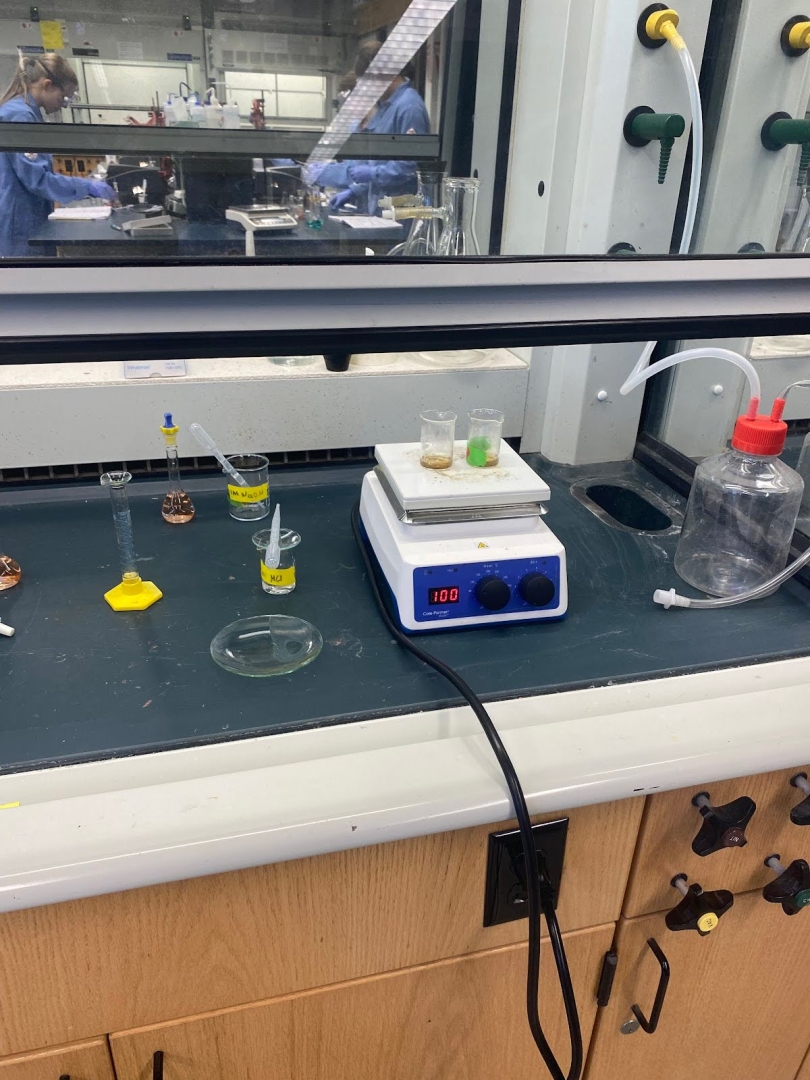
My experimental setup for the synthesis of some solutions in the lab. We had to work under fume hoods due to highly concentrated chemicals!
Apart from the labs, we often had demonstrations by our professor, which he occasionally allowed us to try if it was a relatively safe experiment. From sending corks flying across the lecture hall to changing the speeds of reactions, we definitely had a lot of fun seeing what new things he could surprise us with.
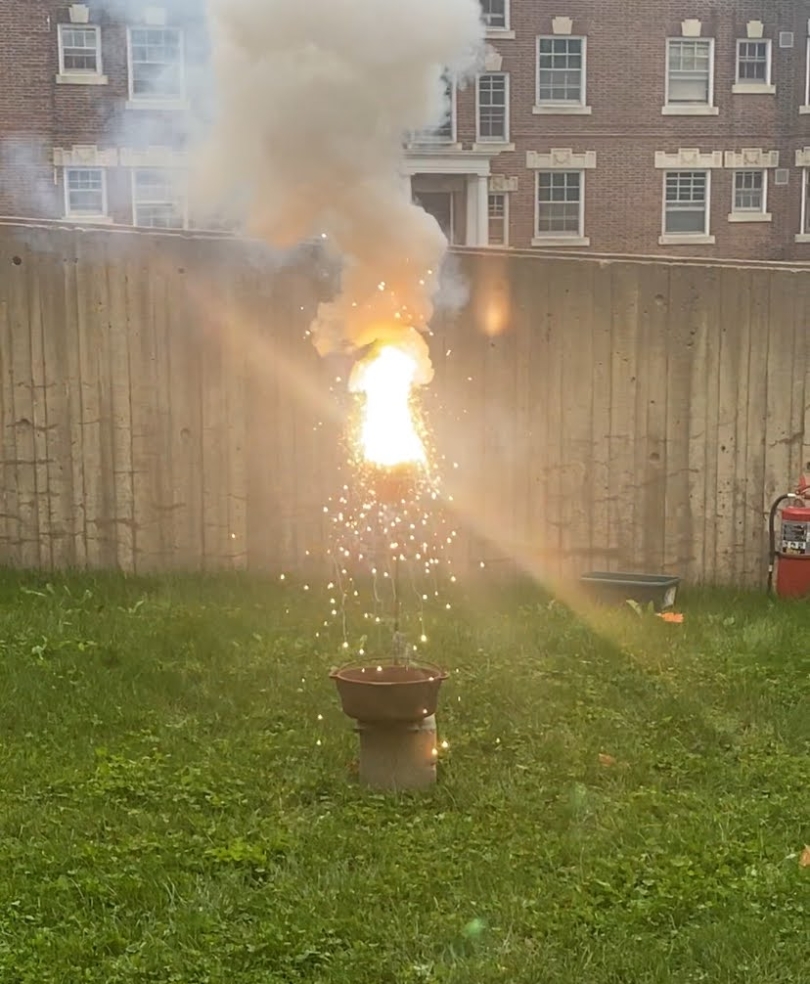
A timed reaction done by our professor at the end of a class period. You could feel the heat from a couple of meters away!
My experience with experiments at Dartmouth has been fun so far—even though it's a lot to do every week, I find the lab sessions fun and engaging. It feels great to put into practice what we learn about in lectures, and I am so excited to take more science courses with labs in the upcoming terms.
One of the first Dartmouth terms you'll hear is the "D-Plan." It might sound confusing at first, but don't worry—read on to learn what it is and how it works!