Hi there! I'm Nathan, a '27 from Lynn, MA (just outside Boston). I'm majoring in Engineering Sciences modified with Studio Art—I like to understand, design, and create things. I also love writing, photography, and being outside (hence this blog). On-campus, I'm involved in the startup scene through the Magnuson Center for Entrepreneurship, as well as the Triathlon and Cycling Teams. Outside of class, you'll probably catch me drinking coffee somewhere or out on my bike.
The Great Issues Scholars (GIS) is a program available to first-year students that brings in guest speakers and hosts simulations on topics of global significance. As the organization that organizes the program, the Dickey Center for International Understanding is Dartmouth's hub for international relations and related opportunities. The topics covered in GIS—most notably international security, global health, and climate change—provide a taste of what the Dickey Center has to offer. I've covered GIS programming in the past; more specifically, I wrote about a wargaming simulation that you can access here.
In my most recent GIS event, I headed over to Rauner Special Collections Library—Dartmouth's home to archival and rare documents. I had visited Rauner in the past (it's an awesome study spot), but this was an opportunity to engage more fully with the library (though some classes actually require that you go to Rauner for assignments!).
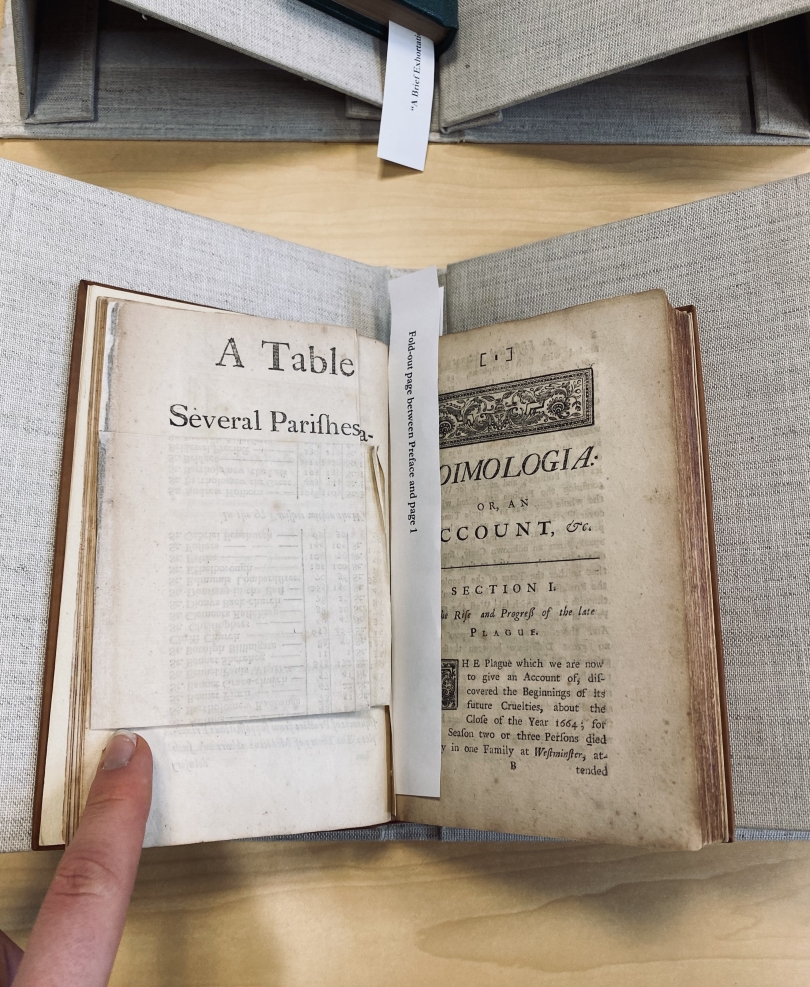
After getting situated in a cozy and rather hidden room, the other GIS students and I examined the documents that were placed on our table. The event essentially consisted of examining and understanding pandemics via the documents that were provided. On our table, there were four leather-bound books from the 1600s that all had different accounts of the Great Plague in London. One focused on the medicinal practices of the time and was written by an MD—the other focused on the religious ramifications and implications. Between the typefaces set by hand, the hand-made covers, and the occasional handwritten notes on each page, the books offered a fascinating glimpse into the reality that was the great plague in London.
It turns out there was a tradition of writing an "s" like an "f" in old english... which is really confusing when initially trying to read these books! (Here "Westminster" looks like "Weftminfter")
Another table had documents that covered the history of the Spanish Flu on-campus. Despite occurring over 100 years ago (1918ish), the story of the Spanish Flu at Dartmouth had surprising parallels to the story of Covid-19. Some of the documentation provided included letters written by students about their experience dealing with the affair (there were the standard complaints of being quarantined and not being able to have the traditional college experience). Apparently the Gymnasium had been used as a medical space for overflow patients—a measure that's eerily similar to the measures taken only a few years ago. Other students wrote about acquiring their books, settling into their classes, and one even sketched an overhead map of campus. Again, it was surprising to see how much hadn't changed and how much had. While Dartmouth's campus has vastly expanded and grown since then, the general experience of students seems relatively similar.
I'm now realizing that as I write these words, I'm also becoming part of Dartmouth's history. That's part of why creating anything here is so amazing—it's here to stay. Maybe another student, many years from now, will read this post and analyze what student life was like in the 2020s.
If you are interested in pursuing medicine after graduating from high school, as I was, you'll be looking at how different universities design their "pre-health" experience. What does that experience look like at Dartmouth College?
Welcome back to Open Doors—your inside look at life in the Woods! This week, Isabelle Sullivan '26, an environmental studies and geography major, showed me around her room, where we discussed Dartmouth residence halls, classes, and campus life.
There was never a single "aha!" moment of clarity when I knew that Dartmouth was right for me, yet now, it is impossible for me to imagine having chosen anywhere else.
From a tight-knit study abroad cohort to intimate classroom moments and inspiring literary talks, French has grown far beyond a minor — becoming a thread that runs through the most meaningful parts of her Dartmouth life.