I'm Kalina, a '27 from Sofia, Bulgaria. I love books (I love reading and writing them), and I particularly love fantasy (i.e., I'm an expert on Middle Earth and Hogwarts studies). I'm equally fascinated by the human brain and storytelling, and I often think about the importance of stories when trying to understand the human mind. I also love hiking, bird-watching, climbing, and em dashes.
It's 6:30 on a Sunday morning. It's still dark outside, and the only light flowing into the quiet room comes from the streetlamp beside Dartmouth Hall. I had to wake up early, but somehow I didn't feel drowsy (unlike all the other days), and I didn't dread getting up. There's something about waking up while it's still dark, knowing that that day's going to be a day full of adventures, that warms you up as though you've just had a cup of steaming cocoa and reminds you of the times when you were little and had to wake up to go skiing.
To put it another way, that Sunday morning I felt happy and a bit nostalgic.
Hiking boots, a windbreaker, and a Terry Pratchett novel–I was ready to go bird watching. (Before we continue, you probably wonder, though: What do Terry Pratchett novels and bird watching have in common?! Essentially, nothing. It's just that the Bulgarian editions of Terry Pratchett's books are small and light enough to fit in your pocket, so these are the best books to bring when hiking or birdwatching!) So here we go.
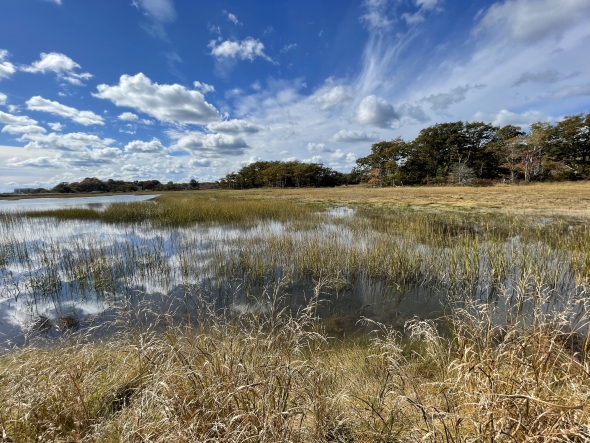
The nearby salt marsh
There were around ten of us in the bus, heading with Wyatt and Avery to the Atlantic Ocean to look for cool birds and seals. (Don't get your hopes high, we didn't see any seals.) On the bus, as surprising as it was, some of my friends just pulled out their laptops and started working. What can I tell you? Bird-watching preparedness means different things to different people. I brought in Terry Pratchett's The Fifth Elephant; my friends brought in their homework.
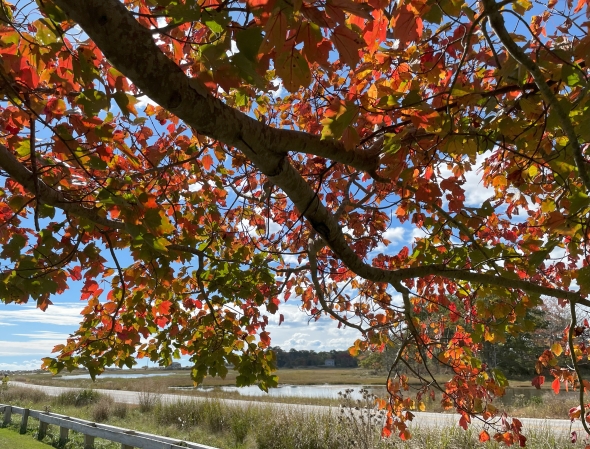
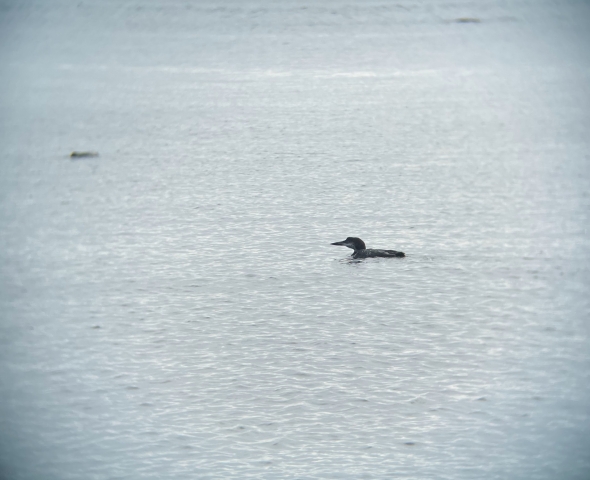
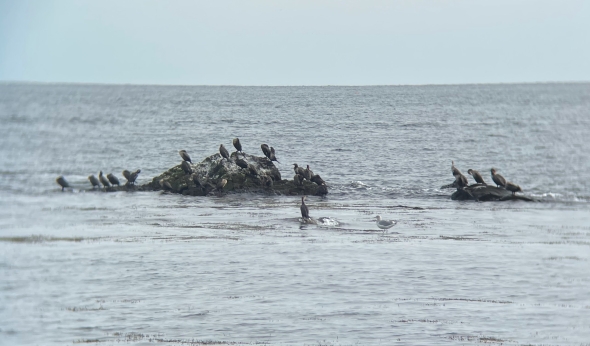
After two hours of driving–or two hours of sleeping with your laptop in your lap–we arrived. The quiet sea reflected the gray sky, making the red autumn trees seem even redder in the background. Two common loons were swimming in the bay, disappearing underwater every now and then, in search of breakfast. A family of cormorants had gathered on top of a nearby rock, black against the cloudy sky like the spikes of a black crown. And I guess we were also a bit like a noisy family of cormorants, fussing on the beach with our binoculars, making the people around us think we were looking at something marvelously cool. Nothing of the sort, dear people. Just cormorants and loons. We WERE looking for something marvelously cool–seals and a female king eider, known to live only in this bay–but we didn't see any of these.
A common loon
A family of cormorants
I wasn't too disappointed, though. Almost every bird we saw was new to me–from the American pipits to the yellow-rumped warbler, so almost every bird was special.
"How do you go on such a trip, though?" You want to ask me. "You went to the ocean and saw some cool birds. But how do I do it, too?" Well, there's a website called Trailhead, where all of the subclubs of the Dartmouth Outing Club announce their trips for the week–they announce their trips' destinations and the needed equipment (which is rarely anything more than a jacket and good shoes), and you just sign up. It's that easy, and that hard. And that's what birding and trailheads have in common. :)
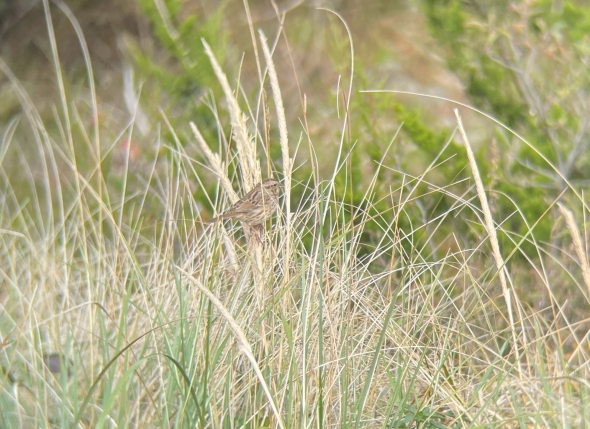
Possibly a song sparrow - I just don't remember what Wyatt said this sparrow was... (Sorry, Wyatt.)
If you're like I was—staring at your closet wondering what "essentials" actually means—here is what I packed, what I'm grateful I brought, and what I now know you can leave behind.
New England's most iconic clock tower, captured from every angle and in every season! From sunrises to snowfalls, here's Baker Tower in all its glory. A visual love letter to Dartmouth's most timeless landmark.